realitybitesartblog

  • Subscribe to our RSS feed.
  • Twitter
  • StumbleUpon
  • Reddit
  • Facebook
  • Digg
Showing posts with label history of photography. Show all posts

Wednesday, 31 August 2011

Bite 142: Julia Margaret Cameron - Julia Jackson, 1867

Posted on August 31, 2011 by niten

Julia Jackson, 1867,  albumen print, 30 x 24.6 cm

Julia Margaret Cameron’s expert use of light and shadow is ground-breaking. In this image of Julia Jackson, Cameron’s niece and Virginia Woolf’s mother, the figure is almost lost in darkness, light rimming her face and exquisitely defining a taut tendon on her neck, evidence of the sitters inner tenacity.

This is a widow facing life alone with strength. She has blinked during the exposure bringing a veiled quality to her eyes and reinforcing the impression of inner contemplation. Her tightly bound hair is just as expressive as the unkempt hair in The Echo or The Mountain Nymph, Sweet Liberty, conveying a potential for wild disarray.

She may not be facing the camera directly but she is very much a dynamic representation of the Victorian female - commanding in her beauty and strength.
Read More
Posted in black and white, history of photography, photo, photography, portrait | No comments

Tuesday, 30 August 2011

Bite 141: Julia Margaret Cameron - Mary Mother, c. 1866

Posted on August 30, 2011 by niten
Mary Mother, c. 1866,  albumen print, 34.9 x 27.1 cm
It is said that all photographs are in a way self-portraits and there is certainly an element of the autobiographical within Cameron’s oeuvre, a product perhaps of her status as (technically) an ‘amateur’ photographer in the sense that she was not bound by commercial interests or economic necessity. 
 
An example of this self-referentiality can be seen in Mary Mother. Pensively, she gazes absently out of the frame, the only indication of the role being played the robes around her neck and over her head; a substitute for the untamed hair in other Cameron images. 
 
We know without explanation that this is Mother Mary following Christ’s death. She is a woman in grief, sacred while at the same time individually human.
 
Modelled by Mary Hillier, a housemaid to Cameron and her favourite and most frequent model, (depicted separately as both the Virgin Mary and Mary Magdalene), Cameron explains, “In every manner of form has her face been reproduced, yet never has it been felt that the grace of the fashion of it has perished.” 
 
In this image Hillier can actually be seen as a stand in for Cameron, who herself lost a child. The tenderness of the image betrays a deep understand of the suffering depicted.
Read More
Posted in black and white, England, history of photography, photo, photography, portrait | No comments

Monday, 29 August 2011

Bite 140: Julia Margaret Cameron - The Echo, 1868

Posted on August 29, 2011 by niten
The Echo, 1868,  albumen print, 27 x 22.6 cm
“Photographs state the innocence, the vulnerability of lives heading towards their own destruction, and this link between photography and death haunts all photographs of people.”
                                                                                 - Susan Sontag, On Photography
Part of what draws us to Julia Margaret Cameron’s images is that, coupled with the exquisite melancholy of her figures and the originality of her technique, is the knowledge that none of their subjects could be alive today. 
 
Considering the relative youth of the invention of photography this is a fairly recent development, and in the inevitable death of their subjects the conceptual cycle of her images is completed. 
 
This combination of the theme of mortality along with that of the photographically unique that-has-been adds profound theoretical interest to a modern reading of Cameron’s images. One of Cameron’s most haunting portraits in this respect is The Echo, modelled by the tragic actress Ellen Terry. 
 
With her particularly piecing yet absent gaze, and pale skin she almost resembles a corpse, the title referencing Greek mythology and perhaps also the inherently reflexive nature of the photographic medium.
Read More
Posted in black and white, England, history of photography, photo, photography, portrait | No comments

Sunday, 28 August 2011

Bite 139: Julia Margaret Cameron - The Mountain Nymph, Sweet Liberty, 1866

Posted on August 28, 2011 by niten
The Mountain Nymph, Sweet Liberty, 1866,  albumen print, 36.5 x 28.6 cm
Julia Margaret Cameron’s aim was “to ennoble photography and to secure for it the character and uses of High Art by combining the real and the ideal and sacrificing nothing of Truth by all possible devotion to Poetry and Beauty.” To attain the status of High Art it was necessary to depict classical and religious subject-matter but if she had achieved only this she would not appeal to a modern sensibility as she does. 
 
The power of her images comes directly from the fact that they are startling traces of those who have lived and stood before her camera; what Roland Barthes refers to as “that-has-been”. 
 
Take The Mountain Nymph, Sweet Liberty as an example. Modelled by Cyllene Margaret Wilson, an orphan adopted by Cameron, the title refers to the Milton poem Allegro. The young girl looks out at the viewer with a direct yet softened stare, her hair tousled and stormy behind her, alternating light and dark. She is in transition, an adolescent moving from darkness into light, from girlhood to womanhood. 
 
Herschel praised the image, calling her, “Absolutely alive and thrusting out her head from the paper to the air.” 
 
Alive she certainly was/is, and as the viewer stares her directly in the face the ambiguity of the image and its allegorical title charges the image with questions: “Who was this girl?” “What kind of life did she live?” “Was she happy?” These are questions that haunt the viewing of many of Cameron’s images and they are so strong only because we are before photographs – emanations of reality.
Read More
Posted in black and white, England, history of photography, photo, photography, portrait | No comments

Saturday, 27 August 2011

Bite 138: Julia Margaret Cameron - The Kiss of Peace, 1869

Posted on August 27, 2011 by niten
The Kiss of Peace, 1869,  albumen print,  34.3 x 27.7 cm
Julia Margaret Cameron's work can be seen as the first example in the history of art of a sustained photographic exploration of women by a woman. Nicole Cooley sees Cameron’s work as decidedly proto-feminist pointing out that “rather than portraying woman’s face as the object of the (male) gaze, Cameron invokes a secret, private world of women together, involved with one another.” Carol MacKay defines it as a “transpersonal” representation in which women represent both themselves and the concept of a higher “collective self.”

In the case of The Kiss of Peace she sees their gazes as providing “a sense of transpersonal dispersion.” Two girls are shown embracing, one laying her lips upon the forehead of the other. But in contradiction to the rather sentimental title she does not appear to be offering any sort of kiss, and the conveyance of the image is more one of melancholy than of a peaceful optimism. Together but alone the figures gaze, in traditional Cameron fashion, towards nothing, one looking up, the other down. 
 
In what MacKay refers to as “creative negativity” many of Cameron’s portraits, particularly those of women, convey a deep melancholy, a meditation on the plight and hardships of Victorian women. This psychological space, intimate and somewhat claustrophobic, can be seen as a reflection of Cameron’s own confined world, one in which inner creativity becomes a way of escaping imprisonment. 
 
Her exploration of the photographic medium is inextricably entwined with this transpersonal view of womanhood. The dichotomy of the divine and the human within her work is matched by the paradox of presenting both the personal – photographs of individual woman; and the transpersonal – woman depicted as allegories: metaphors for human (and often uniquely female) experiences.
Read More
Posted in England, history of photography, photo, photography, portrait | No comments

Friday, 26 August 2011

Bite 137: Julia Margaret Cameron - Iago, Study from an Italian, 1867

Posted on August 26, 2011 by niten
Iago, Study from an Italian, 1867, Albumen print
Portraying a man with tenderness and compassion as opposed to lifting him up as a 'Man of Genius', Iago, Study from an Italian is an image unique within Julia Margaret Cameron’s work.

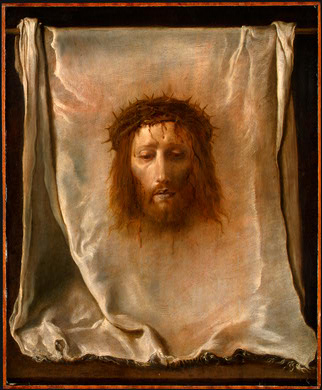
Strongly resembling Domenico Fetti’s painting of Christ with lowered eye, it is possible that Cameron avoided profanity by labelling it instead as the betrayer – more a Judas than a Christ – from Shakespeare’s Othello. But the image of Christ is nonetheless visible, albeit a gloomy or even sinister depiction of the Ecce Homo. As Mike Weaver asks, “Could we not have here a preposterous and beautiful attempt to depict Christ?”
 
Front-on and close-up, the role, modelled by Angelo Colarossi (probably the only paid professional model Cameron ever used), is portrayed with no props and only the hint of a dark robe. The long, wild hair frames the face along with a strong jaw showing several days of stubble. Even without showing the eyes Cameron again utilises the gaze, dark pits indicating an emotional intensity behind a stalwart exterior. 
 
The power in the portrait is more in what it withholds from the viewer than in what it gives away, which is decidedly very little. Yet the unmistakable feeling is one of suffering, deep sorrow and concentration. Somewhere between Christ and Judas, strong and fearful, alive and dead, this could perhaps be the most ambiguous image within a photographic project largely defined by ambiguity.
Read More
Posted in black and white, England, history of photography, photo, photography, portrait | No comments

Thursday, 25 August 2011

Bite 136: Julia Margaret Cameron - Thomas Carlyle, 1867

Posted on August 25, 2011 by niten

 Thomas Carlyle, 1867,  albumen print, 33.7 x 24.5 cm
“From the first moment I handled my lens with a tender ardour, and it has become to me as a living thing, with a voice and memory and creative vigour."                      
                                                    – Julia Margaret Cameron, The Annals of My Glass House, 1874
Julia Margaret Cameron’s dynamic portrait of Thomas Carlyle utilises ambiguity in technique to compelling affect in a portrait made up almost of only smudges and smears on the collodion glass surface streaked with the application of the light-sensitive coating. Yet the image portrays all the more feeling for this, his eyes, similarly to Herschel’s, vacant in contemplation – “staring eagerly into emptiness" - as Carol MacKay puts it, his bright white hair framing his profile, his head filling the frame, arresting the viewers’ attention. 
As with many of Cameron’s portraits the subject is given little context with a deep black surrounding the figure. Movement is evident in what must have been an exposure of several minutes, yet this only adds to the pure energy of the portrait. 
As Roger Fry points out, comparing Cameron to more recent portraitists, “The slight movements of the sitter gave a certain breadth and envelopment to the form and prevented those too instantaneous expressions which in modern photography so often have an air of caricature.” 
Cameron has not captured so much a likeness or a moment, as a manifestation of genius. Carlyle wrote that sitting for this portrait was an “inferno” and this is certainly evident in the resulting portrait, while Cameron described him paradoxically in her Annals as “almost the embodiment of a prayer,” recognising a transcendence which is present in this haunting image.
Read More
Posted in black and white, England, history of photography, photo, photography, portrait | No comments

Wednesday, 24 August 2011

Bite 135: Julia Margaret Cameron - Sir John Herschel, 1867

Posted on August 24, 2011 by niten

Sir John Herschel, 1867,  albumen print,  34.9 x 26.1 cm
“I longed to arrest all beauty that came before me, and at length the longing has been satisfied.”
– Julia Margaret Cameron, The Annals of My Glass House, 1874
Sir John Herschel stares off, glassy eyed, to the right of the frame. What he is looking at is not important, instead it is clear that he is in a kind of meditation – “intently seeing beyond the immediate present” as Carol Hanbery MacKay puts it in her essay The Singular Double Vision of Julia Margaret Cameron.
His hair is wild under his set back beret indicating the mental action going on beneath the hat, which seems to be barely maintaining the activity within it. It is reported that Cameron washed and fluffed up his white hair before the shoot. For, “when I have had such men before my camera”, Cameron reports in her autobiographical fragment Annals of My Glass House from 1874, “my whole soul has endeavoured to do its duty towards them in recording faithfully the greatness of the inner as well as the features of the outer man.” 
Cameron waited several years for the opportunity to photograph her old friend Herschel, who had introduced her to the photographic process as early as 1839 – the year the Daguerrean invention was first revealed to the public in Paris by Louis-Francois Arago.
Highly affected by Herschel’s character and intellect she successfully translates this impact in one of her most famous images, effectively harnessing the narrative power of hair and the eyes, emotive elements focused on in many of Cameron’s portraits.
Read More
Posted in black and white, England, history of photography, photo, photography, portrait | No comments

Monday, 21 March 2011

Bite 80: Robert Frank - U.S. 285, New Mexico, 1956

Posted on March 21, 2011 by niten
U.S. 285, New Mexico, 1956, from the book The Americans, 1958
"Long shot of night road arrowing forlorn into immensities and flat of impossible-to-believe America in New Mexico under the prisoner's moon."
                                                                - Jack Kerouac (Introduction to The Americans)
Read More
Posted in Beat Generation, black and white, history of photography, landscape, photo, travel, USA | No comments

Sunday, 20 March 2011

Bite 79: Ansel Adams - Moonrise, Hernandez, New Mexico, 1941

Posted on March 20, 2011 by niten
Moonrise, Hernandez, New Mexico, 1941
"A true photograph need not be explained, nor can it be contained in words."
                                                                  - Ansel Adams
Read More
Posted in black and white, history of photography, landscape, locality, photography, quotation, quote, USA | No comments

Wednesday, 16 February 2011

Bite 62: J. W. Black - Walt Whitman, c. 1860

Posted on February 16, 2011 by niten
"Whitman late in his life identified the date of this photo as between 1845 and 1850, but no one has agreed with him; Dr. Bucke guessed 1856, but most estimates have been a later date. Seeing this photo late in his life, Whitman exclaimed, "How shaggy! looks like a returned Californian, out of the mines, or Coloradoan," but he was fascinated with "the expression of benignity" that shone through, though he felt "such benignity, such sweetness, such satisfiedness - ” it does not belong. I know it often appears - ” but that's the trick of the camera, the photographer." Whitman called it his "young man" picture ("when did I not look old? At twenty-five or twenty-six they used already to remark it"), and claimed "it is me, me, un formed, undeveloped - ”hits off phases not common in my photos." He described his physique at the time: "I was very much slenderer then: weighed from one hundred and fifty-five to one hundred and sixty-five pounds: had kept that weight for about thirty years: then got heavier." Whitman was amused by the clothing - "how natural the clothes! . . . the suit was a beautiful misfit, as usual, eh?" - and he was impressed with "its calm don't-care-a-damnativeness - ”its go-to-hell-and-find-outativeness: it has that air strong, yet is not impertinent: defiant: yet it is genial." Whitman was mystified by this portrait - ”he began calling it "the mysterious photograph" - ”when he first saw it in 1889: "When it could have been taken - ”by whom - ”where - ”I cannot even guess. . . . it's a devilish, tantalizing mystery. . . .""
                                                                        -  The Walt Whitman Archive
Read More
Posted in black and white, history of photography, photo, photography, poetry, portrait, quotation, quote, USA | No comments

Thursday, 20 January 2011

Bite 43: William Henry Fox Talbot - The Open Door, 1843

Posted on January 20, 2011 by niten
The Open Door, 1843
This is the birth of photography as an art form. Plate 5 from Talbot's groundbreaking photobook (one of the first ever) The Pencil of Nature - an apt descriptor for the new medium - he explained the work as an example "of the early beginnings of a new art." 

The first to see this potential, Talbot invented the calotype photographic process in England simultaneously with Niépce and Dageurre's invention in France. Although it was not blessed with the same initial success as the daguerreotype, it can be seen as perhaps a more foundational invention in the history of photography. Being a negative/positive process it was possible to create countless images from the initial negative thus becoming the basis for almost all succeeding processes. 

With The Open Door Talbot is not only exploring the capabilities of his new invention - "especially useful for naturalists since one can copy the most difficult things, for instance crystallization's and minute parts of plants, with great detail" - but he is also specifically emulating seventeenth-century Dutch paintings of scenes from everyday life. Photo-historian Larry Schaaf points out that the photograph draws on the doorway as a traditional symbol of the passage between life and light, and death and darkness. 

The broom is positioned diagonally against the doorway. The deep darkness of the interior, with only a hint of light from a window, emphasises a mystery and ambiguity.

Talbot has clearly taken deep consideration over the image's composition, and even the time of day for the negative to be exposed to increase contrast and utilise shadow as an aesthetic element - parallel to the broom - as well as to bring out texture in the door.

Although certainly relying heavily on the medium of painting - as much early photography which aspired to art did - The Open Door none-the-less represents the beginning of an ongoing exploration and tension within the medium over the relationship between photography and the history of art.

Sources:
Mary Warner Marien, Photography: A Cultural History, Lawrence King, 2002.
Read More
Posted in black and white, England, history of photography, photo, photography | No comments

Bite 42: Louis Daguerre - Boulevard du Temple, c. 1838

Posted on January 20, 2011 by niten
Boulevard du Temple, c. 1838
This is probably the first portrait photograph ever taken - albeit somewhat unintentionally. During a several-minute-long exposure Louis Daguerre, who is seen as a co-inventor of the photographic medium, has captured a pedestrian who has stopped to have his shoes shined. 

No other subject or vehicle shows up. Only this anonymous figure was still long enough to become a silhouette on the light sensitive surface of the daguerreotype - a technology which was yet to be announced to the world.

With a mundane activity he has unwittingly made photographic history.
Read More
Posted in black and white, France, history of photography, photo, photography, portrait | No comments

Wednesday, 19 January 2011

Bite 41: Joseph Nicéphore Niépce - View from the Window at Gras, 1826

Posted on January 19, 2011 by niten
View from the Window at Gras, 1826
The first 'photograph'. Although controversially regarded so, Niépce's View from the Window at Gras is none-the-less widely seen as the earliest existing photographic image.

The technology for the recording and fixing of light - through the invention of the camera obscura and the discovery of light sensitive silver halide - existed for many years prior to this image being created. Here Niépce brings the two discoveries together - one chemical, the other optic.

Taken from an upstairs window of his country estate near Chalon-sur-Saône by an eight hour exposure - light can be seen on opposing buildings - the grainy image can only be seen with intense manipulation and an increase in contrast. Then a blurry landscape emerges. 

Taken as an experiment, Niépce surely had no full comprehension of how radical this breakthrough was, how world changing the birth of this medium would become.
Read More
Posted in black and white, France, history of photography, photo, photography | No comments

Thursday, 6 January 2011

Bite 33: Roger Fenton - The Valley of the Shadow of Death, Crimea, 1855

Posted on January 06, 2011 by niten
The Valley of the Shadow of Death, Crimea, 1855
"Once he left his studio, it was impossible for the photographer to copy the painters' schema. He could not stage-manage the battle, like Uccello or Velázquez, bringing together elements which had been separate in space and time, nor could he rearrange the parts of his picture to construct a design that pleased him better.
From the reality before him he could only choose that part that seemed relevant and consistent, and that would fill his plate. If he could not show the battle, explain its purpose, its strategy, or distinguished its heroes from its villains, he could show what was too ordinary to paint: the empty road scattered with cannon balls, the mud encrusted on the caisson's wheels, the anonymous faces, the single broken figure by the wall.
Intuitively, he sought and found the significant detail. His work, incapable of narrative, turned to symbol."
                                                              - John Szarkowski
The most significant of early war photographs. It features no soldiers, wounded bodies, corpses or active conflict. This is the earth scarred after war, debris covering the ground, cannon balls scattered, the sky above stark white.

A Modernist take on war, the strength of the image is in its ambiguity, in its brutal minimalism. As Szarkowski points out, devoid of narrative or figure, the earth, the details of the cannon balls, speak volumes.

Source:
John Szarkowski, The Photographer's Eye, Museum of Modern Art, 1966.
Read More
Posted in black and white, death, England, history of photography, photo, photo journalism, photography, war | No comments

Wednesday, 5 January 2011

Bite 32: Arthur Rothstein - Mr and Mrs A. B. on their Farm near Kersey, Colorado, 1939

Posted on January 05, 2011 by niten
Mr and Mrs A. B. on their Farm near Kersey, Colorado, 1939
A farmer and his wife photographed for the Farm Security Administration by Arthur Rothstein. The purpose of the small but highly influential FSA photography program between 1935 and 1944 was to raise national awareness in the United States on the plight of the rural poor.

This couple seems immensely pleased to have been chosen to be photographed and noticeably proud of their produce, which they hold up to the camera. The fruits of their labour - a still-life of sorts adding to the success of the composition. Going from the roughness of Mr A. B.'s skin, complemented by the bark of the tree he stands against, his labour must surely be hard. Yet for this sitting he has carefully combed his hair and his wife is certainly wearing her favourite dress.

A tender image of rural domesticity, Rothstein none-the-less manages to transcend the cliche, presenting the couple in essentially human terms with honesty and integrity.
Read More
Posted in black and white, history of photography, photo journalism, photography, portrait, USA | No comments

Saturday, 25 December 2010

Bite 23: Unknown - Couple Holding Daguerreotype, c. 1850

Posted on December 25, 2010 by niten
Couple Holding Daguerreotype, c. 1850, daguerreotype
There are three subjects in this highly reflexive image: a man, a woman, and a photograph. From the couple's solemn expressions - one looking away, the other confidently apprehending the lens, fist clenched - it would appear the family in their precious daguerreotype (they clearly value this image, holding it tenderly on a pedestal; far more than today we would value a material image) it seems the people in the image must have past, or be physically distant from them, the couple grieving on time past just as it is 'present', in some frustrating form, with them here.

It being a work by an anonymous artist/photographer heightens the mystery and ambiguity already present in the image. We do not know these people or their names. This object - an object of an object - has been separated from its extended family, yet we are intensely interested in this couple and what they are feeling here. The interest lies also in that we are unsure what the very purpose of this image even is, the life it lived for these people.

Photographs, as icons of nostalgia, are objects which seem to grow in authenticity and interest as they age. It seems appropriate then, and even adds to the value of this object, when it is scratched, damaged or even smashed.

This image, a powerful statement on what photographs are and mean to us, has an entire new life of its own, fully divorced from the people it depicts and its intended purpose. Perhaps unintentionally Couple Holding Daguerreotype comments strongly on the simultaneous tangibility and ephemerality of photographs, and their subjects. This image is well deserving of long meditation.
Read More
Posted in black and white, death, history of photography, photo, photography, portrait | No comments
Older Posts Home
Subscribe to: Posts (Atom)

Popular Posts

  • Bite 153: Henri de Toulouse-Lautrec - The Bed, 1893
    The Bed , 1893, oil on cardboard, 51.3 x 70.4 cm, Musee d'Orsay, Paris "For a long time I used to go to bed early. Sometimes, when ...
  • Bite 158: Leonardo da Vinci - Drapery Study for an Angel, c. 1495-8
      Drapery Study for an Angel , c. 1495-8, ink on paper, 21.3 x 15.9 cm, Collection of Her Majesty The Queen, UK. Skin beneath cloth, finely ...
  • Bite 156: Ejnar Nielsen - And In His Eyes I Saw Death, 1897
    And In His Eyes I Saw Death , 1897, Oil on canvas, 188 x 137 cm, National Gallery of Denmark

Categories

  • abstraction
  • American Realism
  • animals
  • Argentina
  • art history
  • Baroque
  • Beat Generation
  • Biblical
  • black and white
  • book
  • book shop
  • books
  • bookshop
  • bookstore
  • Chile
  • colour
  • Conceptual Art
  • contemporary art
  • death
  • Denmark
  • drawing
  • England
  • France
  • Funk
  • gay
  • gender
  • genre painting
  • Germany
  • Greece
  • history of photography
  • Impressionism
  • installation
  • Italy
  • Korea
  • LA
  • landscape
  • literature
  • locality
  • London
  • lyrics
  • Medieval
  • Mexico
  • mixed-media
  • Modern Art
  • museums
  • music
  • myth
  • Nabis
  • Neo-Classicism
  • Neolithic
  • Netherlands
  • New York
  • New Zealand
  • non-western art
  • nude
  • NYC
  • Op Art
  • painting
  • Paris
  • pastel
  • Performance Art
  • personal
  • photo
  • photo journalism
  • photography
  • poetry
  • Pop Art
  • portrait
  • Post-Colonialism
  • Pre-Raphaelite
  • prehistoric
  • public art
  • quotation
  • quote
  • Realism
  • Renaissance
  • Romanticism
  • Samoa
  • sculpture
  • self portrait
  • Spain
  • still life
  • Sublime
  • Surrealism
  • Tahiti
  • tapestry
  • travel
  • USA
  • video
  • war

Blog Archive

  • February 2012 (2)
  • January 2012 (9)
  • December 2011 (1)
  • November 2011 (3)
  • September 2011 (3)
  • August 2011 (9)
  • July 2011 (5)
  • June 2011 (14)
  • May 2011 (18)
  • April 2011 (17)
  • March 2011 (16)
  • February 2011 (21)
  • January 2011 (24)
  • December 2010 (8)
Powered by Blogger.

Report Abuse

  • Home

About Me

niten
View my complete profile

Search This Blog